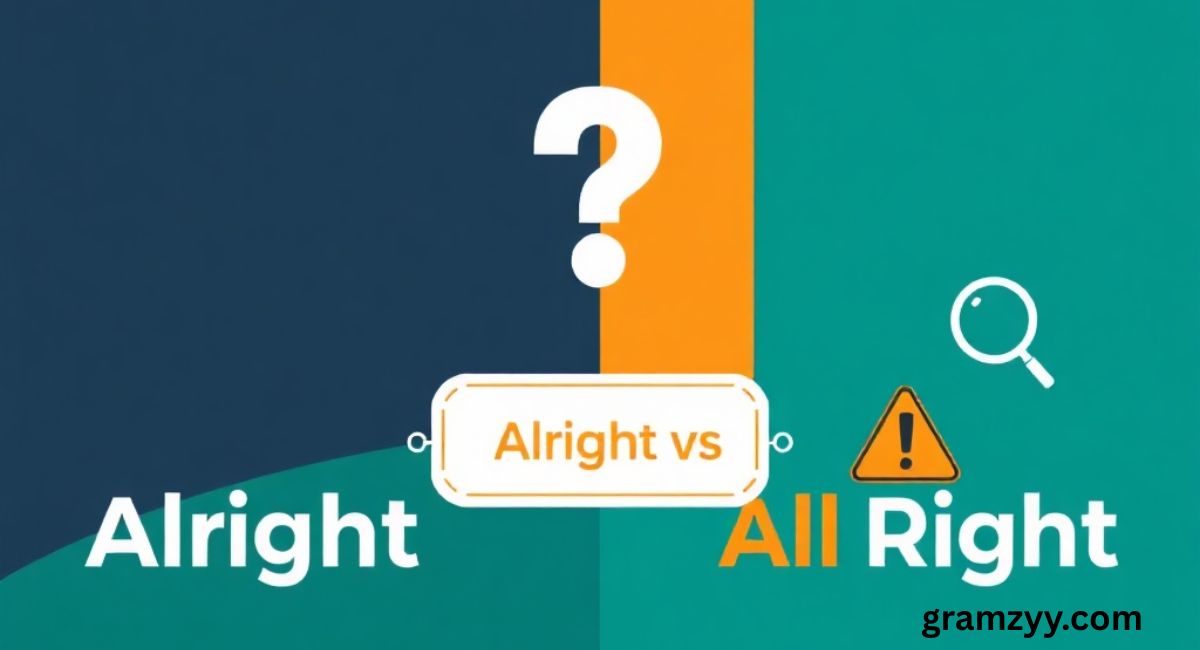
Alright vs All Right: ⚡ Quick Answer Both alright and all right are correct, but they serve different purposes. All right is the universally accepted, formal spelling — safe for essays, business documents, and academic writing. Alright is widely used in informal contexts, dialogue, and creative writing, though some style guides still flag it as nonstandard.
You stop mid-sentence, cursor blinking. You’ve typed the word a thousand times — but today, for some reason, it looks wrong. Is it one word or two? You type “alright,” then delete it and type “all right,” then wonder if that looks oddly stiff. Sound familiar?
You’re not alone. This small spelling question has fueled grammar debates for over a century, divided editors and novelists, and still triggers red squiggly lines in word processors today. Let’s settle it once and for all.
Why Does Your Brain Keep Second-Guessing This Choice?
English is full of words that began as two-word phrases and eventually fused into one: already, altogether, although, always, almost. Your brain sees that pattern and naturally assumes alright belongs in the same club — because it looks like it should.
The problem is timing. Already and altogether merged into single words during the Middle Ages, long before spelling was standardized. By the time alright appeared in print in the late 1800s, English spelling had hardened into rules — and alright arrived just in time to be called a mistake by the language critics who were now very much paying attention.
So the confusion isn’t a sign of carelessness. It’s a natural response to a genuine inconsistency baked into the language itself.
Core Concepts and Historical Evolution
Etymology and the Path of Lexical Consolidation
The phrase all right traces its roots to Old English. All derives from the Old English word eall, meaning “every” or “the whole of,” while right comes from Germanic and Latin roots carrying the meaning of “straight” or “correct.” Together, all right originally meant something close to “everything is correct” — a literal reading that still survives in certain sentence constructions today.
The earliest modern use of all right as a fixed phrase appears in the early 19th century, seen in works by Shelley (1822) and Dickens (1837). Alright as a single word is considerably younger. It first appeared in literature around 1865, linked to Mark Twain’s short story “The Celebrated Jumping Frog of Calaveras County.” This late arrival — after spelling conventions had already been codified — is precisely why alright has never fully shaken off its “upstart” reputation.
Grammatical Mechanics and the Adverbial Modifier Function
Both forms function as the same parts of speech. They can each serve as:
- Adjective — describing a noun as satisfactory, safe, or acceptable
- Adverb — modifying a verb to mean “well” or “satisfactorily”
- Interjection / exclamation — expressing agreement, emphasis, or readiness
One meaningful grammatical distinction exists, though it’s subtle: the two-word form all right can sometimes function as a phrase where all and right operate independently. In the sentence “Her answers were all right,” all can be read as a quantifier meaning “every one,” making the sentence mean “every answer was correct.” The one-word alright doesn’t carry this ambiguity — it straightforwardly means “satisfactory.”
See also: Quotation Marks When Quoting Yourself: The Complete Guide
Contextual Examples of Alright vs All Right
Formal and Academic Contexts of Alright vs All Right
In formal writing — academic papers, legal documents, business reports, journalistic copy — all right is always the correct choice. Style guides including the AP Stylebook, The Chicago Manual of Style, and Garner’s Modern American Usage all prefer the two-word form. The AP Stylebook goes so far as to say: “Never alright.”
✓ Formal Usage — Correct
“The committee confirmed that all procedures were all right before the audit began.”
“The project timeline is all right, provided the team meets the quarterly milestone.”
“All right, the meeting will resume at 2:00 PM.” (as an interjection)
Casual and Conversational Usage
In text messages, informal emails, dialogue in fiction, song lyrics, and social media, alright is completely natural and widely accepted. It carries a conversational warmth that the two-word form sometimes lacks. Many writers deliberately choose alright to give dialogue a realistic, spoken feel.
✓ Casual Usage — Acceptable
“Alright, let’s grab coffee before the meeting.”
“She’s alright — just a bit shaken up after the fall.”
“Did alright on that exam, honestly.”
✗ Avoid in Any Context
“Allright, let’s begin.” — Allright (with double-L, no space) is never correct under any circumstances. It is a consistent misspelling with no valid usage in formal or informal writing.
The Nuance Trap
Some grammarians argue there is a meaningful semantic difference between the two. Consider:
| Sentence | Meaning | Form Used |
|---|---|---|
| “Her answers were all right.” | Every answer was correct (quantifier reading) | all right |
| “Her answers were alright.” | Her answers were satisfactory / adequate | alright |
| “The kids are all right.” | All of the children are safe / correct | all right |
| “The kids are alright.” | The kids are doing fine (general state) | alright |
⚠ The Nuance Caveat Merriam-Webster notes that “all right” can actually carry both meanings — “correct” and “satisfactory” — which means the distinction above, while useful, is not universally recognized. Use it if you find it helpful, but don’t rely on it to defend using alright in formal writing.
Literary Usage of Alright vs All Right
Classic Literature Usage
Some of the most celebrated writers in the English language have used both forms, which only deepens the debate.
| Author / Work | Form Used | Context |
|---|---|---|
| Mark Twain, The Jumping Frog (1865) | alright | First notable literary appearance of the single-word form |
| James Joyce, Ulysses (1922) | all right (37×) / alright (1×) | Overwhelmingly preferred the two-word form |
| Langston Hughes, various works | alright | Used to capture authentic vernacular voice |
| Flannery O’Connor, fiction | alright | Deployed for regional and colloquial dialogue |
| Theodore Dreiser, manuscripts | alright | His editor H.L. Mencken changed every instance to all right |
| Charles Dickens, Pickwick Papers (1837) | all right | Early formal use of the two-word phrase |
The fact that even James Joyce — who famously bent every grammar rule imaginable — used all right 37 out of 38 times in Ulysses says something worth noting. If the rule-breaker followed the convention, it might be worth considering.
Modern Stylistic Simulation
In contemporary pop culture, both spellings appear with deliberate intent. The Who’s 1965 hit “The Kids Are Alright” chose the informal spelling to match rock music’s rebellious, conversational energy. Director Lisa Cholodenko’s 2010 film “The Kids Are All Right” used the formal spelling — same phrase, different register, different world. Matthew McConaughey’s iconic line “Alright, alright, alright” from Dazed and Confused would lose something essential if respelled as “All right, all right, all right.” The form itself carries meaning.
Synonyms and Variations of Alright vs All Right
Semantic Neighbors and Illocutionary Force
Both alright and all right belong to a rich family of words expressing adequacy, affirmation, or approval. Here are their closest semantic neighbors:
- Okay / OK — the most neutral alternative; works in both formal and informal registers
- Fine — adjective or adverb; slightly more formal than alright
- Satisfactory — decidedly formal; better for professional documents
- Acceptable — formal; implies meeting a minimum standard
- Adequate — formal; conveys sufficiency without enthusiasm
- Sure / certainly — as affirmatives replacing the interjection use
- Indeed / absolutely — stronger affirmatives for formal agreement
Visualizing the Difference in Alright vs All Right
All Right ✓
- Always formally correct
- Academic papers
- Business correspondence
- Legal documents
- News articles
- Preferred by AP Stylebook
- Two-word quantifier meaning available
Alright ✓
- Informal writing & dialogue
- Text messages & social media
- Fiction & creative writing
- Song lyrics & scripts
- Recognized by OED, Merriam-Webster
- Common in British casual speech
- Growing in acceptance since 1980s
Regional Variations
Regional patterns matter here, especially if your audience spans countries:
| Region | Formal Writing | Informal / Spoken | Notes |
|---|---|---|---|
| American English | all right | both used; alright growing | AP Stylebook favors all right exclusively |
| British English | all right | alright more common | OED deems alright “clearly standard in general prose”; used as a greeting (“Alright mate?”) |
| Australian English | all right | both common | Follows British informal norms broadly |
| Global / International | all right | varies | Default to all right when writing for multiple markets |
Google Ngram data shows alright rising in British English books since 1980, growing roughly three times in frequency over that period, while its growth in American English has been considerably slower. Even so, neither region has abandoned all right in formal contexts.
See also: Inquiring Minds Want to Know
Common Mistakes and Psychological Triggers
Beyond the two-word / one-word confusion, a few specific errors pop up repeatedly:
- Writing “allright” — the double-L, no-space version — is never correct. It appears nowhere in any dictionary, style guide, or accepted usage. It’s simply a misspelling of a misspelling.
- Using “alright” in a formal academic paper because it “looks fine” — this is the most common context where it can cost you credibility with professors or editors trained in traditional usage.
- Applying the form inconsistently within the same document — switching between all right and alright in a single piece of writing signals carelessness. Pick one and hold it.
- Assuming British English permits alright everywhere — even in the UK, formal documents follow the two-word rule.
- Over-correcting in dialogue — changing a character’s “Alright, let’s go!” to “All right, let’s go!” may subtly alter the voice and tone of your fictional characters.
The psychological trigger behind most of this confusion is pattern recognition. Your brain has internalized already, altogether, and although — all formerly two words, all now uncontested single words — and it assumes alright earned the same status. It didn’t, quite. Not yet. But it’s closer than your English teacher might admit.
Field Notes from the Editorial Trenches
The divide between all right and alright has historically been described as a battle between writers (who tend to prefer alright) and language authorities (who prefer all right). Theodore Dreiser used alright consistently in his manuscripts — and his editor H.L. Mencken changed every instance. Merriam-Webster’s Dictionary of English Usage notes that alright would appear far more in published text if copy editors were less resistant to it.
Fowler’s Dictionary of Modern English Usage once observed that the choice between them “reveals one’s background, upbringing, education” — a comment that says as much about language snobbery as it does about grammar. The Oxford English Dictionary, more generously, concluded that alright “has become clearly standard in general prose” and that “no very cogent reasons are presented for its being considered wrong.”
✔ Editorial Takeaway If you write for a specific publication or institution, check their style guide. If they specify “all right only,” follow it. If no guide exists, consider your audience: formal setting → all right; casual setting → either works.
Memory Aid
The One Rule That Covers Everything
“When in doubt, two words stand out.”
All right with two words is always right — in every context, for every reader, in every style guide. You can never go wrong with it. Use alright when you’re certain the context is informal or creative, and you know your audience is comfortable with it.
A quicker version: think of “formal” and “two.” Both have more letters than their casual counterparts — formal writing, two words. Casual writing, one word. The length of your deliberation can match the length of your form.
See also: Privy Meaning and How to Use It
FAQs
Is “alright” a real word?
Yes. It is listed in Merriam-Webster, the Oxford English Dictionary, and Collins Dictionary, among others — though many style guides still consider it informal or nonstandard in formal writing.
Which is more commonly used — alright or all right?
All right is significantly more common in published, edited text; alright is more common in informal, digital, and spoken communication.
Can I use “alright” in an academic paper?
It’s best to avoid it. Most academic style guides prefer all right, and using alright in formal academic writing can undermine your credibility with editors and professors.
What does the AP Stylebook say about alright?
The AP Stylebook explicitly states: “Never alright.” For journalistic and press writing, all right is the only accepted form.
Is “alright” more common in British English?
Yes. Informal British usage embraces alright more readily than American English, including as an everyday greeting (“Alright?” meaning “How are you?”). Formal British writing still uses all right.
What about “allright” — is that ever correct?
Never. Allright (double-L, no space) is a consistent misspelling with no legitimate usage in any form of English writing.
Do “alright” and “all right” have the same meaning?
Largely yes, though all right can uniquely convey “every one is correct” (e.g., “all the answers were all right”), a meaning alright doesn’t carry in the same way.
Which should I use in a text message or email?
Either is fine in casual communication; alright reads as more conversational, while all right is also perfectly natural. For professional emails, all right is the safer choice.
Why hasn’t “alright” become fully standard like “already”?
Timing. Already fused into a single word during the Middle Ages, before spelling rules were codified. Alright arrived in the 1800s after standardization, so it was immediately labeled a deviation rather than an evolution. (Alright vs All Right)
Conclusion
The debate over alright versus all right is one of English grammar’s most persistent — and honestly most human — arguments. It pits the instinct for efficiency against the force of convention, the spoken language against the written one, writers against editors.
Here’s the practical bottom line: all right is never wrong. In every context, formal or informal, it is accepted, correct, and clear. Alright is also correct — increasingly so — but carries enough stigma in formal settings that it’s worth being selective. Know your audience, know your context, and when in doubt, reach for the two-word form.
And if anyone ever tells you “allright” is fine? That’s the one mistake that truly is all wrong.