You’re writing a product description, a heartfelt gift message, or a blog post — and suddenly you freeze. Is it jewelry or jewellery? You type one, second-guess yourself, and end up Googling it at 11 PM.
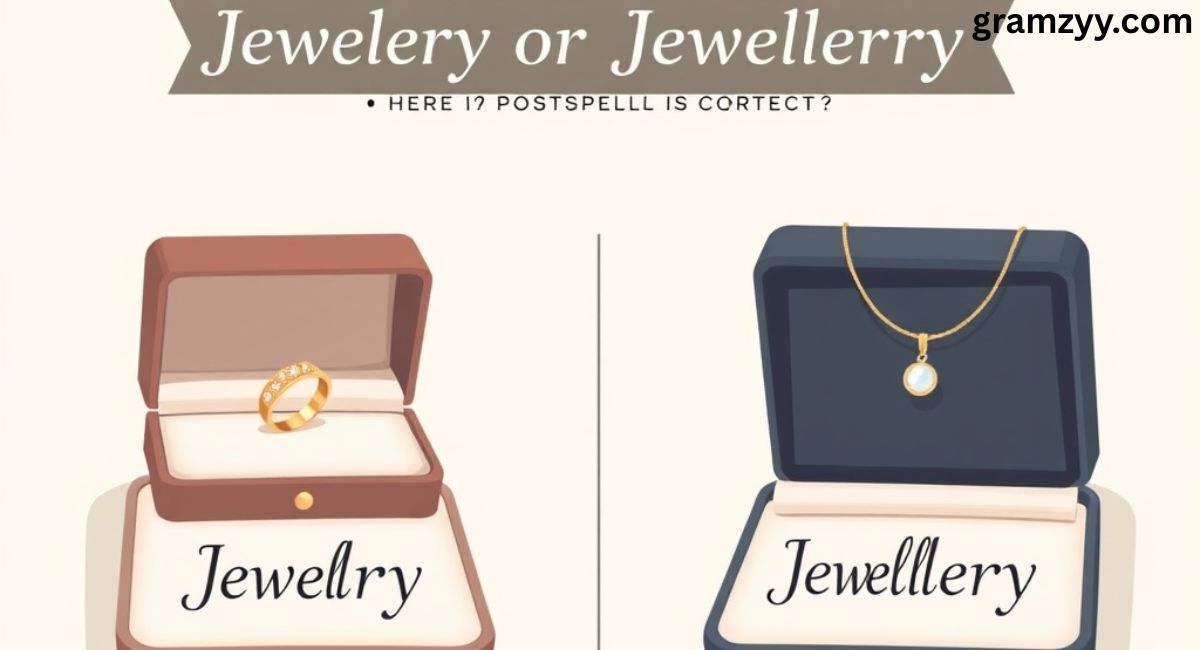
Here’s the short answer: both spellings are correct. Which one you use simply depends on where in the world you (or your audience) are located. This guide breaks down exactly why two spellings exist, how to use them confidently, and which one fits your writing.
Why Do Spellings Differ in Jewelry and Jewellery?
The difference between jewelry and jewellery comes down to one thing: American English vs. British English.
When the United States was establishing its own cultural and linguistic identity in the early 19th century, lexicographer Noah Webster deliberately simplified many British spellings. His landmark dictionary of 1828 helped cement these changes into everyday American usage. Words like colour became color, theatre became theater, and jewellery became jewelry.
The British spelling, jewellery, traces its roots to Middle English juelerye and the Old French jouellerie. French grammar required that a vowel always follow a double “L” — which explains the extra “E” in the British form. Americans, unbothered by this French linguistic rule, simply dropped those extra letters.
The Historical Word Origin
The root word jewel was borrowed from Old French jouel around the 13th century. From this single root, two distinct spelling paths emerged across the Atlantic — yet the meaning has never changed.
See also: Alright vs All Right: Which is correct?
Quick Reference: Jewelry vs. Jewellery at a Glance
| Feature | Jewelry | Jewellery |
|---|---|---|
| Used in | American English | British English |
| Countries | USA | UK, Australia, New Zealand, Ireland |
| Canada | Sometimes used | More commonly used |
| Syllables | 2 (JOO-lree) | 3 (JOO-uhl-ree) |
| Related noun | Jeweler | Jeweller |
| Related adjective | Jeweled | Jewelled |
| Root word | Jewel (universal) | Jewel (universal) |
Jewelry and Jewellery in Real Examples
Seeing both spellings in context from real publications makes the distinction crystal clear.
American English — “Jewelry”
- The New York Times: “Police arrested a man in connection with the robbery of a jewelry store in Manhattan’s diamond district.”
- CNN: “Among his prized possessions was a jeweled robe presented by Elvis Presley.”
- US retail signage, product listings, and brand names universally use jewelry.
British English — “Jewellery”
- The Guardian: “If you keep it subtle and meaningful, men can wear jewellery.”
- BBC News: “A woman was robbed of a piece of jewellery she had advertised online.”
- UK museums, auction houses like Christie’s and Sotheby’s, and luxury brands use jewellery.
Correct Usage Examples
Understanding the correct form for each context prevents embarrassing errors, especially in professional writing.
Correct — American English context:
- “She inherited a stunning collection of jewelry from her grandmother.”
- “The jewelry store on Fifth Avenue closes at 7 PM.”
- “He hired a skilled jeweler to resize the engagement ring.”
Correct — British/Australian English context:
- “The jewellery exhibition at the Victoria and Albert Museum opens next week.”
- “She trained as a jeweller in Birmingham’s famous Jewellery Quarter.”
- “That antique jewellery box belonged to Queen Victoria.”
See also: All Is Well or All Is Good: Which Phrase Is Better?
Incorrect Usage Examples
These examples show what to avoid — not because the spelling is wrong in isolation, but because it mismatches the regional context:
- ❌ Writing jewellery on a product page targeting US customers (creates confusion, hurts SEO)
- ❌ Using jewelry in a formal British publication or UK brand guide (appears unprofessional)
- ❌ Writing jewelery — this misspelling appears in neither standard American nor British English and should always be avoided
Context Variations
Canada and Australia
Canadian English sits between the two traditions. Both jewelry and jewellery appear in Canadian writing, though jewellery is somewhat more common — particularly in formal or editorial contexts.
Australia and New Zealand firmly follow British conventions. Jewellery is the standard in these countries, and using jewelry in Australian publications would stand out as an Americanism.
The Jewellery Industry
Interestingly, even within the United States, the broader trade sector is sometimes referred to as the jewellery industry — a nod to the word’s traditional roots. This inconsistency is rare but worth knowing if you work in the trade.
SEO and Digital Marketing
For businesses selling online, spelling choice has a direct impact on search visibility:
- In the US, Google searches for jewelry vastly outnumber jewellery
- In the UK, Australia, and New Zealand, jewellery dominates local search queries
- Targeting the wrong spelling for your market can quietly cost you organic traffic
If you run an international e-commerce store, consider including both spellings in your metadata, alt text, and blog content to capture both audiences.
Common Mistakes with Jewelry and Jewellery
Even careful writers make these errors. Here’s what to watch out for:
- Writing jewelery — This three-e variant (jew-el-er-y) is not recognized as correct in any major style guide. It’s among the most common misspellings of this word worldwide.
- Inconsistent spelling within one document — Switching between jewelry and jewellery in the same article or website signals carelessness. Pick one and stick with it.
- Assuming British English is “more correct” — Both forms are fully legitimate. Neither is superior; they simply serve different audiences.
- Using the wrong form for your target market — This is particularly damaging for brands. An Australian luxury brand using jewelry on its homepage may appear inauthentic to local shoppers.
- Misspelling related words — If you write jewelry, the related forms are jeweler, jeweled, and jeweling. If you write jewellery, the related forms are jeweller, jewelled, and jewelling. Keep your derivatives consistent.
How to Remember Jewelry vs. Jewellery
Memory tricks make the difference stick:
- “Short American, long British” — American English tends toward shorter, simplified spellings. Jewelry (7 letters) vs. Jewellery (9 letters) follows this pattern perfectly.
- Think of other pairs — Color/colour, theater/theatre, honor/honour. The same rule that explains those differences explains jewelry/jewellery.
- Two L’s = two Oceans away — The double “L” in jewellery belongs to the British side of the Atlantic. One “L” = one American spelling.
- The root word never changes — Jewel is spelled the same everywhere. Just remember that the American version keeps it short and stays close to that root.
Which Spelling Fits Your Readers?
Choosing the right spelling isn’t about personal preference — it’s about respecting your audience.
| Your Audience | Correct Spelling to Use |
|---|---|
| United States readers | Jewelry |
| United Kingdom readers | Jewellery |
| Australian readers | Jewellery |
| New Zealand readers | Jewellery |
| Canadian readers | Either (jewellery slightly preferred) |
| International/global audience | Use both; clarify by region |
If you’re writing for a US-based brand, blog, or retailer — use jewelry. If your content targets the UK, Australia, or Ireland — use jewellery. Your platform is global, consider being explicit (“We ship jewelry worldwide — or jewellery, as our British customers say!”) to signal awareness and build trust across regions.
See also: As the Crow Flies: Meaning, Usage, and Examples
Conclusion
The jewelry vs. jewellery debate has one satisfying answer: both are correct, and neither is a mistake — as long as you’re using the right one for your audience. The American form jewelry is standard in the US, while the British form jewellery is the norm across the UK, Australia, and much of the English-speaking world. The root word jewel, however, is shared universally.
Whether you’re writing a product listing, crafting an editorial, or just settling a dinner-table argument, the rule is simple: know your reader, match your spelling, and stay consistent throughout your writing.
FAQs
Is “jewelry” or “jewellery” the correct spelling?
Both are correct. Jewelry is standard in American English, and jewellery is standard in British English.
Why does the British spelling have more letters?
The extra “L” and “E” in jewellery come from French grammatical rules that require a vowel after a double consonant — a legacy of Old French influence on British English.
Is “jewelery” a valid spelling?
No. Jewelery is a common misspelling and is not accepted in either American or British English.
Which spelling is used in Australia?
Australia follows British English conventions, so jewellery is the correct and preferred spelling there.
How is “jewellery” pronounced differently from “jewelry”?
Jewellery (British) has three syllables: JOO-uhl-ree. Jewelry (American) has two syllables: JOO-lree.
Does Canada use “jewelry” or “jewellery”?
Canadian English uses both, though jewellery appears more frequently in formal Canadian writing.
Which spelling should I use for SEO?
Use the spelling that matches your target audience’s region. Jewelry ranks better in US searches; jewellery performs better in UK and Australian searches.
Are “jeweler” and “jeweller” both correct?
Yes. Jeweler is the American English form and jeweller is the British English form — consistent with the broader spelling difference.