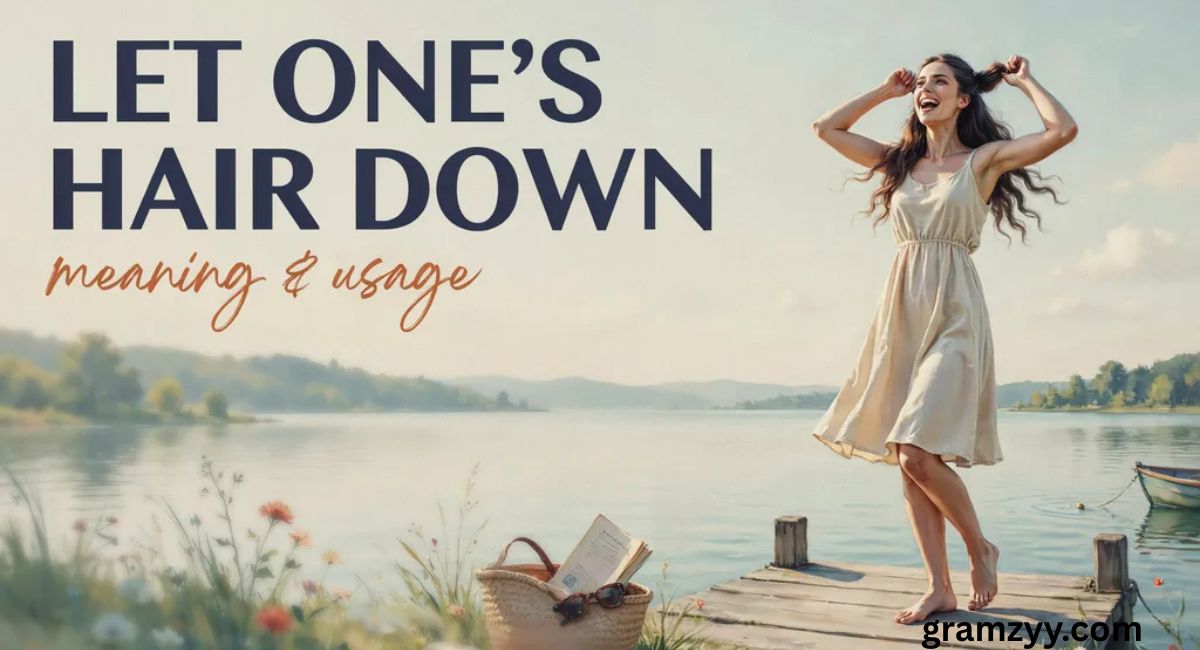
If you’ve ever heard someone say “just let your hair down and have fun,” you probably understood the spirit of it even if the literal image felt odd. This idiom has nothing to do with hairstyles today, yet it remains one of the most commonly used relaxation expressions in English. Whether you’re a student, a writer, or simply an English learner trying to sound more natural, understanding this phrase opens the door to more confident, idiomatic speech.
In this guide, we’ll break down the meaning, history, grammar, and real-world usage of “let one’s hair down,” along with examples, common mistakes, and memory tricks that make it easy to remember for good.
Why Does This Phrase Confuse Non-Native Speakers?
For learners encountering this idiom for the first time, the literal interpretation is a natural first guess. Someone might picture an actual person physically loosening their hair, especially if they’re unfamiliar with English idioms tied to historical customs.
The confusion usually comes from three things:
- The phrase uses a physical action (hair, pins, loosening) to represent an emotional state (relaxation, freedom).
- “One’s” is a placeholder pronoun, so learners often don’t realize it changes based on the subject (my, your, his, her, their).
- The idiom is informal, so it rarely appears in textbooks but shows up constantly in everyday conversation, TV shows, and casual writing.
Once you understand that this is a figurative expression rooted in real social history, the meaning becomes much easier to grasp—and remember.
See also : Prescribe or Proscribe
Core Concepts and Historical Evolution
At its core, “let one’s hair down” means to relax, drop your guard, and behave in a free, uninhibited way after a period of formality, stress, or restraint.
Etymology and Victorian Social Semiotics
The roots of this idiom go back centuries before the Victorian era, but its symbolism became especially pronounced during that period. In the 17th through 19th centuries, women—particularly those in upper-class or formal social circles—were expected to wear their hair pinned, braided, or styled elaborately whenever they appeared in public. This wasn’t just fashion; it was a marker of respectability, status, and self-control.
At home, away from public scrutiny, women would physically unpin their hair before bed or during private moments. This simple act became symbolically linked to stepping out of a formal role and into a private, relaxed version of oneself.
Over time, the literal gesture transformed into a figurative idiom. By the mid-1900s, “let your hair down” was widely used to describe anyone—regardless of gender or hairstyle—choosing to relax, drop social formality, and enjoy themselves freely.
Grammatical Mechanics and Fixed Idiomatic Expressions
Understanding the grammar behind this idiom helps you use it correctly in any sentence.
| Element | Explanation | Example |
|---|---|---|
| Possessive pronoun | Changes based on subject (my, your, his, her, their, our) | She let her hair down |
| Verb “let” | Always paired with “down” in this idiom | Let your hair down |
| Tense flexibility | Works in past, present, and future tense | He lets his hair down on weekends |
| Fixed phrase | Cannot be reordered or substituted loosely | “Let down one’s hair” sounds awkward and unnatural |
The phrase functions as a verb phrase idiom, meaning the words work together as a single unit of meaning. You can’t swap “hair” for another noun and expect the same figurative effect—it’s a fixed expression.
Contextual Examples
Seeing the idiom in different settings helps clarify when it’s appropriate—and when it isn’t.
Formal/Academic Context
In academic or professional writing, the idiom is rarely used directly because of its informal tone. However, it may appear when discussing workplace culture, stress management, or social behavior:
- “Employees reported feeling more productive after company events that encouraged staff to let their hair down.”
- “Researchers noted that individuals who occasionally let their hair down experienced lower reported stress levels.”
Casual/Conversational Context
This is where the idiom truly shines. It’s common in everyday speech, texts, and informal writing:
- “It’s Friday night—let’s let our hair down for once!”
- “After finals week, I just want to let my hair down and binge a show.”
- “You’ve been working so hard lately. Maybe it’s time to let your hair down a little.”
The Nuance Trap
One subtle nuance learners often miss: the idiom implies a contrast with a prior state of formality, stress, or restraint. It doesn’t simply mean “to have fun”—it specifically implies relief from tension or rules.
For example, saying “I let my hair down while doing my taxes” doesn’t quite work, because there’s no implied formality being shed in that activity. The idiom works best when there’s a clear “before and after”—formal to casual, tense to relaxed, controlled to free.
How Writers Use “Let One’s Hair Down”
Writers across genres have used this idiom to add color, relatability, and rhythm to their prose.
Classic Literature
Older English texts used variations of this phrase to describe characters stepping away from societal expectations, particularly female characters whose public behavior was tightly controlled. The imagery of literally unpinning hair served as a visual metaphor for emotional release, often marking a turning point in a character’s story—a moment of vulnerability, honesty, or freedom.
Modern Stylistic Use
Contemporary writers, bloggers, and content creators use the idiom to:
- Add a conversational tone to articles
- Describe workplace culture or team-building events
- Frame travel, vacation, or lifestyle content around relaxation
- Add personality to dialogue in fiction or scripts
Its flexibility makes it a go-to phrase whenever a writer wants to signal a shift from “buttoned-up” to “easygoing” without sounding clinical.
See also : Is Used vs Has Been Used vs Was Used
Synonyms and Variations
While “let one’s hair down” has a unique flavor, several other idioms express similar ideas.
Semantic Neighbors
| Idiom | Meaning | Best Used For |
|---|---|---|
| Let loose | Act freely, without restraint | Parties, group settings |
| Blow off steam | Release built-up stress or frustration | After a hard task or conflict |
| Kick back | Relax passively, do nothing | Lazy afternoons, downtime |
| Chill out | Calm down or relax casually | Informal, often younger speech |
| Take it easy | Avoid stress, slow down | Advice or reassurance |
| Unwind | Gradually relax after tension | After work or a busy schedule |
Each of these idioms carries a slightly different shade of meaning. “Blow off steam” suggests releasing frustration through activity, while “let one’s hair down” leans more toward social ease and self-expression.
Regional Variations
The phrase is widely understood across English-speaking countries, but usage style differs slightly:
- American English: Common in casual, everyday speech—often used among friends or coworkers.
- British English: Slightly more traditional in tone, sometimes appearing in writing with a touch of formality or humor.
- Australian English: Used similarly to American English, often paired with social or party contexts.
Despite regional flavor, the core meaning remains consistent worldwide.
Common Mistakes
Even confident English speakers occasionally misuse this idiom. Watch out for these errors:
- Wrong word order – Saying “let down one’s hair” instead of “let one’s hair down.”
- Literal interpretation – Assuming the phrase only applies to people with long hair (it applies to everyone, regardless of hairstyle).
- Using it in the wrong context – Applying it to situations that don’t involve relaxing after formality or stress (e.g., routine tasks).
- Mismatched pronouns – Forgetting to adjust “one’s” to match the subject (he/his, she/her, they/their).
- Overuse in formal writing – The idiom is casual; overusing it in professional documents can feel out of place.
Practical Tips and Field Notes
The Editor’s Field Note
When editing content that includes this idiom, check for two things: context and consistency. Does the sentence imply a shift from formal to relaxed? And does the possessive pronoun match the subject correctly? These two checks resolve most issues with this phrase.
Also, avoid pairing it with overly technical or serious topics—it works best in lifestyle, social, or conversational writing where a friendly tone is appropriate.
Mnemonics and Memory Aids
To remember the meaning, picture this: Pinned up = formal. Let down = relaxed.
You can also link it to a simple phrase: “Hair up, guard up. Hair down, guard down.” This mental image ties the literal action to the figurative meaning, making it easier to recall during conversation or writing.
See also : Giving or Given
Conclusion
“Let one’s hair down” is a vivid, time-tested idiom that captures something universal: the human need to occasionally step away from rules, expectations, and stress. Rooted in centuries-old social customs, the phrase has evolved into a flexible, gender-neutral expression used in conversations, literature, and everyday writing across the English-speaking world.
By understanding its history, grammar, and proper context, you can use this idiom naturally and confidently—whether you’re chatting with friends, writing a blog post, or simply trying to sound more like a native speaker.
FAQs
What does “let one’s hair down” mean?
It means to relax, drop formality, and behave freely and comfortably, especially after a period of stress or restraint.
Where does the idiom come from?
It originates from historical customs where women wore their hair pinned up in public and let it down in private as a sign of relaxation and informality.
Is this idiom only used for women?
No. While its origins relate to women’s hairstyles, the phrase is now gender-neutral and applies to anyone, regardless of hair length or style.
Can I use this idiom in formal writing?
It’s best suited for casual or conversational writing. In formal contexts, consider alternatives like “unwind” or “relax.”
What’s a good synonym for “let one’s hair down”?
“Let loose,” “chill out,” and “unwind” are common alternatives with similar meanings.