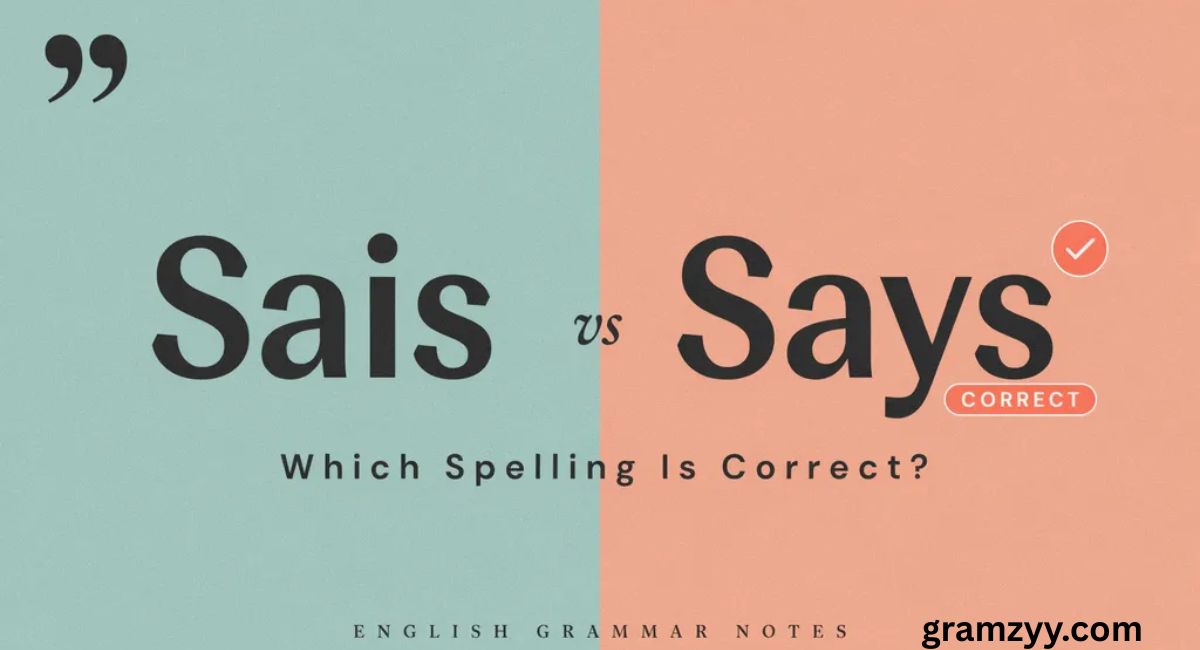
Sais vs Says: If you’ve ever typed “sais” and then paused to wonder whether that looked right — you’re not alone. This is one of the most common spelling slip-ups in written English, and it happens to native speakers and language learners alike. The short answer? “Says” is the only correct spelling. “Sais” is a misspelling, full stop.
But understanding why helps you avoid the error permanently. This guide breaks down the grammar rule behind “says,” shows you real-world examples, and gives you a memory trick you’ll never forget.
Is “Sais” Ever Correct in English?
No. “Sais” is not a standard English word. It does not appear in any major English dictionary — not Merriam-Webster, not Oxford, not Cambridge — as a form of the verb “say.” When you see it in writing, it is always a mistake.
There are two rare, niche exceptions worth mentioning purely for completeness:
- As a plural noun: “Sai” is a traditional Okinawan martial arts weapon (like a short trident). Its plural is sometimes spelled “sais.” This has nothing to do with the verb “say.”
- In older French-influenced texts: “Sais” exists in French (meaning “I know”), but that connection does not transfer to English usage.
Neither exception applies to everyday English writing. When someone writes “He sais he’ll be there,” they mean “He says he’ll be there” — and it’s simply wrong.
Bottom line: If you’re writing about what someone says, speaks, tells, or expresses, the only correct spelling is says.
Sais vs Says: Examples Across Real Contexts
Correct Usage: “Says” in Practice
“Says” is the third-person singular present tense of the verb “say.” Use it whenever your subject is he, she, it, or any singular noun.
| Subject | Correct Form | Example Sentence |
|---|---|---|
| He | says | He says the meeting starts at noon. |
| She | says | She says she’ll call back later. |
| It | says | It says “no entry” on the door. |
| The report | says | The report says profits are up. |
| Everyone | says | Everyone says this is the best route. |
| The committee | says | The committee says the vote is final. |
Notice the pattern: no matter what singular subject precedes it, the verb is always “says.” The spelling does not shift based on formality, region, or context.
See also : Roofs vs Rooves: Which Plural Is Correct?
Incorrect Usage: Common Errors and Corrections
Here are the most frequent “sais” mistakes spotted in emails, essays, and social posts — along with their corrections:
| Incorrect ❌ | Correct ✅ |
|---|---|
| He sais he is tired. | He says he is tired. |
| My teacher sais this is wrong. | My teacher says this is wrong. |
| The sign sais “No Parking.” | The sign says “No Parking.” |
| She sais she’ll come tomorrow. | She says she’ll come tomorrow. |
| The doctor sais you need rest. | The doctor says you need rest. |
| My mom sais dinner is ready. | My mom says dinner is ready. |
Every single instance of “sais” above is a spelling error. There is no grammatical context in which “sais” replaces “says” as a verb.
Context Variations: How the Rule Holds Across Registers
One of the most useful things to understand about “says” is that it never changes, regardless of the situation:
Reported (indirect) speech:
- Present: She says she will attend the conference.
- Past: She said she would attend the conference.
Note that the past tense is “said” — not “sais.” “Sais” is not the past tense either.
Formal writing:
- The contract says payment is due within 30 days.
- The court ruling says the defendant must comply.
Informal conversation:
- He says he’s coming.
- She says the pizza place is closed.
Collective nouns (American English):
- The team says it’s ready to compete.
- The board says the budget is approved.
In British English, collective nouns can sometimes take a plural verb (“The team say they’re ready”), but “says” remains correct when the group is treated as a single unit.
See also : Mom vs Mum: What’s the Difference?
Why Do Writers Keep Spelling Says Wrong?
The answer comes down to one thing: pronunciation.
“Says” is pronounced “sez” — rhyming with “fez” or “Liz.” It does not sound like “sayz.” That gap between the written word and its spoken sound trips up even experienced writers.
Here’s what happens in the brain: a writer hears the /sɛz/ sound and tries to reconstruct the spelling phonetically. “Sez” doesn’t look right, so they reach for “sais” — which at least contains the letters a, i, and s. It feels plausible. But English spelling does not always follow phonetic logic, and “says” is a classic example of that.
Several other factors make this mistake common:
- English learners often come from languages where words are spelled exactly as they sound. Spanish, Italian, and many other languages follow more consistent phonetic rules. English does not.
- Typing speed: When writing quickly — in emails, chat messages, or social media — the hand follows the ear rather than the grammar rule.
- Limited reading exposure: Writers who haven’t seen “says” in print frequently enough haven’t locked the correct spelling into long-term memory.
- No spell-check alert: Some word processors do not flag “sais” as a misspelling, which means it slips through unnoticed.
Understanding why this error happens makes it easier to catch in your own writing before it reaches a reader.
Which Memory Trick Works Best for Spelling “Says”?
The most reliable trick is also the simplest: look inside the word.
“Says” contains the word “say.” say + s = says
Once you see that “say” is sitting right at the beginning of “says,” the spelling explains itself. You’re not inventing a new word — you’re just adding one letter to a word you already know.
Here are a few more techniques that work well:
- The base-word method: Every time you write “says,” mentally start with “say” and add the “s.” This builds a habit that replaces the phonetic reflex within days.
- The conjugation table trick: Write out the full present tense conjugation of “say” somewhere visible: Subject Verb I say You say He / She / It says We say They say Seeing “says” in its proper grammatical slot reinforces both the spelling and the grammar rule simultaneously.
- The vowel rule reminder: “Say” ends in a vowel (a) followed by y. When a verb ends in vowel + y, the third-person singular form just adds s — no changing y to i, no adding es. So “play” becomes “plays,” “stay” becomes “stays,” and “say” becomes “says” — never “sais.”
- Read more, write more: The most permanent fix is exposure. The more you encounter “says” correctly used in books, articles, and news, the more it embeds itself as the default spelling in your memory.
See also : Checkup vs Check-Up — Which Is Correct?
FAQs
Is “sais” ever acceptable in any form of English?
No. “Sais” is never acceptable as a verb form of “say” in any variety of standard English — British, American, Australian, or otherwise. (sais vs says)
Why does “says” sound like “sez”?
English preserves historical spellings even when pronunciation has drifted. The word “says” has been spelled this way for centuries; the spoken form shifted, but the written form did not.
Can spell-check catch “sais”?
Not always. Some editors flag it, but many do not — especially if “sais” is used in a martial arts context (the plural of “sai”). Always proofread manually for this error.
Is “says” the same in British and American English?
Yes. Both British and American English spell and use “says” identically. There is no regional variation. (sais vs says)
Conclusion
The “sais vs says” debate has exactly one answer: “says” is correct, and “sais” is not a word in standard English grammar. It is the third-person singular present tense of “say,” formed simply by adding an s to the base verb.
The fastest way to eliminate this error from your writing is to remember one thing: see “say” inside “says.” Start from the root word, add the s, and you’ll never reach for “sais” again.
Whether you’re writing a business email, a school assignment, or a social media post, the rule is the same: He says, she says, it says — always with that clean, simple s at the end.