If you’ve ever typed this word and paused fingers hovering over the keyboard wondering whether it ends in -ion or -ian, you’re not alone. The “accordion vs accordian” debate trips up musicians, web developers, students, and writers every single day. The answer is clear, definitive, and backed by every major dictionary in the English language. Let’s settle it once and for all.
The Correct Spelling: Why “Accordion” Wins
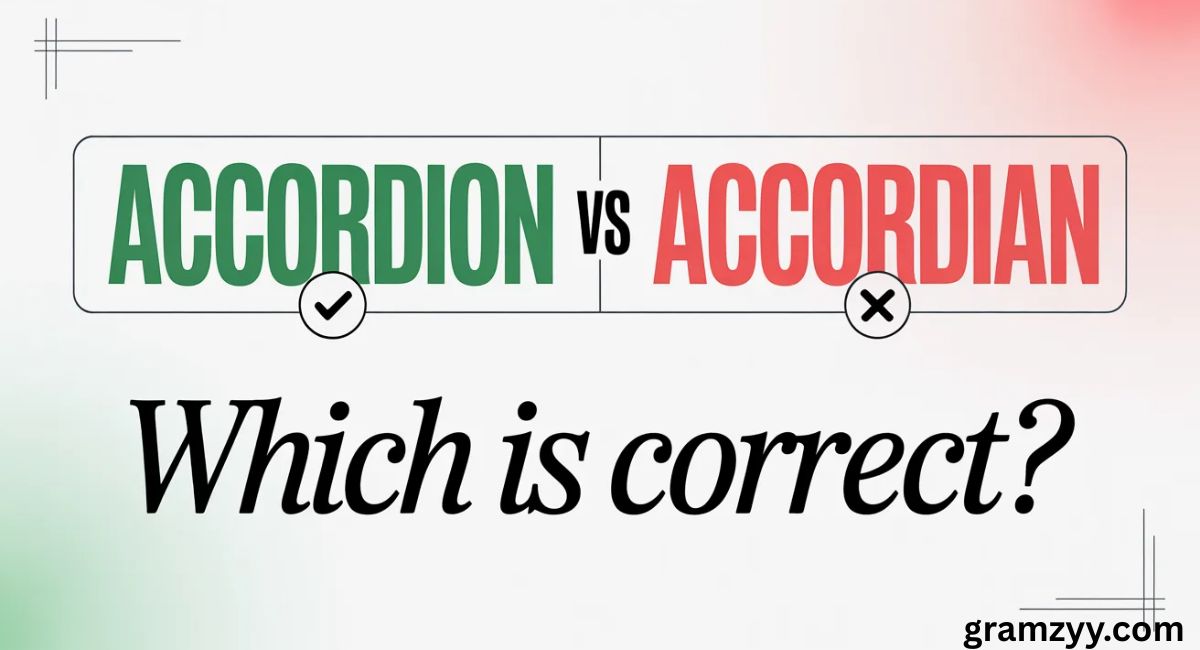
The correct spelling is accordion. Full stop.
The variant accordion is a misspelling it does not appear in Merriam-Webster, Oxford, Cambridge, Collins, or any other recognized linguistic authority. No dialect, regional variation, or style guide accepts accordion as a standard form. It’s simply an error, and a remarkably common one at that.
Here’s the one-line rule to carry with you forever:
Accordion = ✅ Correct | Accordian = ❌ Always wrong
How to Use “Accordion” Correctly
Correct Usage
The word accordion functions as both a noun (the instrument) and an adjective (describing a folded, expandable style). Both are spelled the same way.
| Context | Example Sentence |
|---|---|
| Musical instrument | She learned to play the accordion at age seven. |
| Adjective (pleated style) | The folder used an accordion file system. |
| Web/UI design | The sidebar uses an accordion menu for navigation. |
| Describing a style | The skirt featured accordion pleats along the hem. |
Incorrect Usage
Avoid these misspellings in any context formal or informal:
- ❌ He played the accordian at the festival.
- ❌ The accordian-style menu loaded slowly.
- ❌ She bought a new accordian from the music store.
Context Variations
The word accordion appears across surprisingly varied fields:
- Music: Piano accordion, button accordion, diatonic accordion
- Fashion: Accordion pleats, accordion skirts
- Office supplies: Accordion folders, accordion files
- Web development: Accordion menus, accordion dropdowns (collapsible UI components)
- Data science: Accordion charts used in interactive dashboards
In every single one of these contexts, only accordion is correct.
See also Unselect or Deselect
Common Mistakes with Accordion vs Accordian
Spelling errors don’t happen randomly they follow patterns. Understanding why people write Accordian is the first step to never writing it yourself.
Why This Misspelling Happens
There are several consistent reasons behind this spelling mistake:
- Phonetic confusion: When you say accordion aloud, the ending sounds like “dee-uhn” which the brain naturally maps to the familiar – ian pattern.
- Pattern interference: English is full of – i an words musician, librarian, guardian, historian, vegetarian. The brain applies this pattern by instinct.
- Spell-check blind spots: Some basic spell-checkers fail to flag accordian because it resembles a plausible English word structure, making it harder to catch.
- Illusory truth bias: When someone sees a misspelling repeated across websites and social media, the brain begins to accept it as correct over time.
- Muscle memory: Writers who have typed accordian repeatedly develop a physical habit that’s hard to break without conscious effort.
How to Remember “Accordion”
Good news: a few simple tricks make this spelling stick permanently.
The “Accord” Connection
Break the word down and you’ll immediately see its core: accord + ion.
The word accord means harmony or agreement — exactly what a musical chord expresses. Accordion is literally “the instrument of accord.” Since accord is a word you already know how to spell, just add -ion to the end and you’re done.
ac + cord + ion → accordion ✅
The Double-C Rule
Notice that accordion carries a double-C right at the start: accordion. This mirrors related English words built on the same root:
- accord
- according
- accordance
- accordingly
All of these share the double-C pattern from their Latin/French roots. Accordion is simply this family’s musical member.
The “Never -IAN” Rule
Remind yourself: accordion names a thing, not a person. Words ending in -ian almost always describe people or origins — musician, Canadian, librarian. An accordion is an object, not a person, so it takes the object suffix -on, not the person suffix -ian.
Quick mental check: Is it a person or a place? Then -ian. Is it a thing? Then think twice — and in this case, it’s -ion.
Visualizing the Spelling
Try these mnemonic anchors:
- “The accordion plays on and ON” the word ends in -on, reinforcing the -ion ending.
- Break it into chunks: ac – cord – i – on. Say “cord” in the middle, and finish with “ion.”
- The bellows rule: Imagine the accordion’s bellows expanding outward. They go “on and on” — just like the -ion ending.
Word Origins: Why the Double-C Exists
Understanding etymology makes spelling feel logical rather than arbitrary.
The word accordion entered English around 1830–1831, borrowed directly from the German Akkordeon. That German word was itself built from Akkord (meaning “musical chord” or “harmonic concord”) which traces back through French accord and ultimately to Latin accordare, meaning “to bring into harmony” (literally “to bring heart to heart,” from ad- + cor, meaning “heart”).
The instrument itself was patented in Vienna in 1829 by piano-maker Cyrill Demian, who gave it its name. The double-C spelling travel intact through this entire linguistic journey from Latin, through French, into German, and finally into English. The -ion suffix was added following the same model as other instrument names of the era, like Melodion.
So when you see the double-C in accordion, you’re looking at nearly 200 years of linguistic history preserved in two letters.
Synonyms and Related Terms
While accordion is the standard English word, musicians and enthusiasts use several related terms:
| Term | Meaning |
|---|---|
| Squeeze box | Casual/slang term for the accordion |
| Concertina | A related free-reed instrument with hexagonal ends |
| Melodeon | A small diatonic button accordion common in folk music |
| Piano accordion | An accordion with a piano-style keyboard |
| Button accordion | An accordion using buttons instead of piano keys |
| Bayan | The Russian term for a chromatic button accordion |
| Accordionist | A person who plays the accordion |
| Free-reed instrument | The instrument category accordion belongs to |
All of these terms are spelled without the -ian ending. Notice that accordionist the word for the player — also uses accordion as its root, not according .
Quick Reference: Accordion vs Accordian at a Glance
| Feature | Accordion | Accordian |
|---|---|---|
| Correct spelling | ✅ Yes | ❌ No |
| Found in dictionaries | ✅ Yes | ❌ No |
| Used in formal writing | ✅ Yes | ❌ Never |
| SEO impact | ✅ Positive | ❌ Hurts rankings |
| Professional credibility | ✅ Maintained | ❌ Undermined |
FAQs
Is “accordian” ever acceptable in any context?
No. There is no dialect, region, or style guide that accepts accordian as correct. It remains a spelling error in all contexts, formal and informal alike.
Why does “accordion” sound like it ends in “-ian”?
The spoken word ends in an unstressed syllable that sounds like “dee uhn,” which the brain maps to familiar – ian words. The sound is misleading spelling must follow etymology, not phonetics.
Does the misspelling “accordian” affect SEO?
Yes, significantly. Using the wrong spelling in metadata, headings, or content can reduce search visibility and damage professional credibility with readers who know the correct form.
How do you pronounce “accordion” correctly?
The standard pronunciation is uh-KOR-dee-uhn, with stress on the second syllable. IPA: /əˈkɔːr.di.ən/.
What is the adjective form of accordion?
The word accordion itself serves as an adjective when placed before a noun accordion menu, accordion folder, accordion pleats. No separate adjective form is needed.
Are “accordeon” and “accordion” the same?
Accordéon is the French spelling, occasionally used in Irish traditional music communities, but accordion is the accepted standard in English writing.
Conclusion
The accordion vs accordian debate has exactly one right answer: accordion. It’s the only spelling recognized by English dictionaries, used by music professionals, accepted in academic writing, and indexed correctly by search engines.
The misspelling accordian exists because spoken English can mislead even careful writers — but once you understand the word’s roots in accord and its -ion suffix, the correct form becomes second nature. Remember: ac + cord + ion, the double-C, and the fact that -ian belongs to people — not instruments.
Spell it right, and you carry 200 years of linguistic history with every word you write.