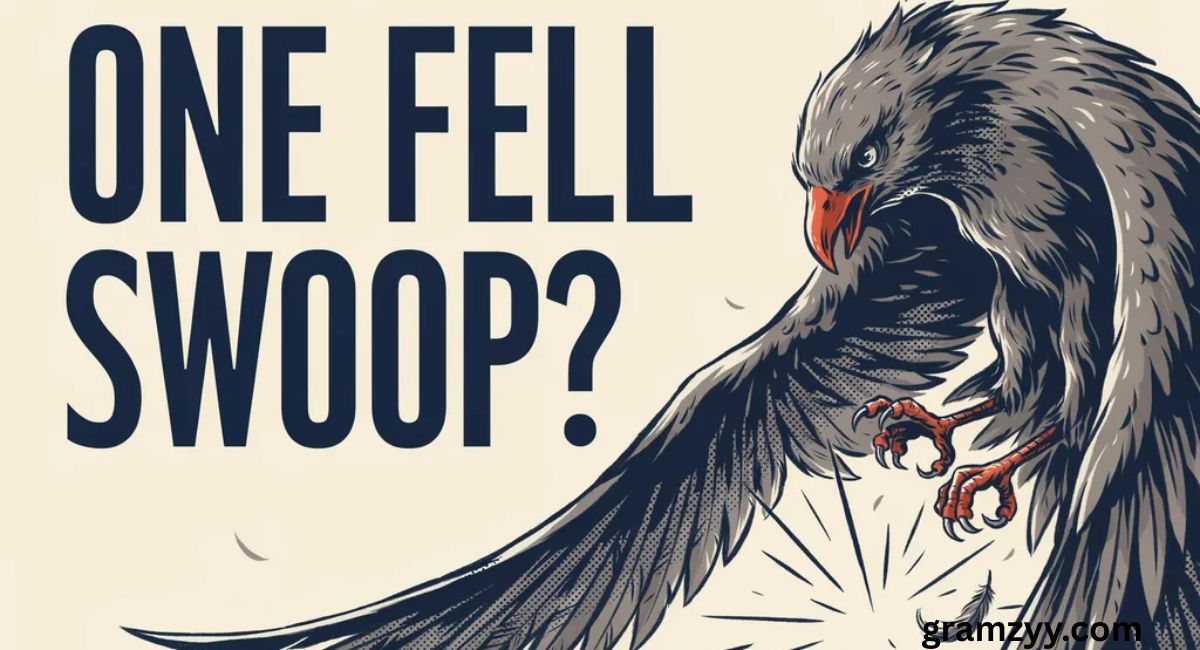
If you’ve ever heard someone say they finished a project, packed their bags, or fixed every problem “in one fell swoop,” you’ve probably understood the gist — even if the wording felt a little odd. That’s because “one fell swoop” is one of those English idioms that survives from a much older form of the language, yet still feels right at home in everyday conversation.
This guide breaks down exactly what “one fell swoop” means, where it came from, how to use it correctly, and the mistakes most people make with it. By the end, you’ll be able to use this phrase confidently in writing and speech without second-guessing yourself.
What Does “One Fell Swoop” Mean?
“One fell swoop” means doing something suddenly, completely, and in a single action. When several things happen at the same time, or one move accomplishes everything at once, that’s a textbook case of “All at once.”
The phrase combines two words that rarely appear anywhere else in modern English:
- Fell – an old adjective meaning fierce, cruel, or deadly (not related to “fall”)
- Swoop – a sudden, sweeping downward motion, like a bird of prey diving on its target
Put together, the original image was violent: a predator striking all at once, with devastating force. Over the centuries, the harsh meaning faded, but the sense of suddenness and completeness stayed exactly the same. Today, “All at once“ simply describes a single decisive action that gets everything done at once — for better or worse.
How Is “One Fell Swoop” Used in a Sentence?
Grammatically, “All at once” functions as part of an adverbial phrase. It usually follows the preposition “in” (less commonly “at”), and it describes how an action happens — not what the action is.
A few quick rules:
- It modifies a verb or an entire action, not a noun.
- It pairs naturally with verbs like finish, complete, solve, eliminate, wipe out, fix, or change.
- It implies the action happened quickly, all at once, and without leaving anything unfinished.
Basic sentence pattern:
[Subject] + [verb describing a completed action] + in one fell swoop.
Example: “The new policy eliminated three outdated rules in All at once.”
Notice that the phrase sits at the end of the sentence, quietly emphasizing how efficiently the action was carried out.
One Fell Swoop in Real Examples
Seeing the idiom in context makes it much easier to internalize. Below are correct examples, common errors, and how the phrase shifts across different settings.
Correct Usage Examples
| Sentence | Why It Works |
|---|---|
| She cleaned out her entire closet in one fell swoop. | One continuous action completes the whole task. |
| The company restructured three departments in one fell swoop. | A single decision affects multiple areas at once. |
| A power outage knocked out the internet, phones, and lights in one fell swoop. | Several effects happen simultaneously from one cause. |
| He answered all of his emails in one fell swoop before lunch. | Emphasizes speed and completeness of one session. |
Incorrect Usage Examples
| Incorrect Sentence | Issue | Corrected Version |
|---|---|---|
| He fixed the bugs one fell swoop at a time. | Contradicts “one” — implies multiple separate actions. | He fixed all the bugs in one fell swoop. |
| She slowly completed the report in one fell swoop. | “Slowly” conflicts with the idea of suddenness. | She completed the report quickly, in one fell swoop. |
| They made a one fell swoop decision. | The phrase can’t act as a direct adjective before a noun. | They made the decision in one fell swoop. |
| The renovation happened in one foul swoop. | Misspelling of “fell” changes the meaning entirely. | The renovation happened in one fell swoop. |
Context Variations
The tone of “All at once” shifts slightly depending on where it’s used:
- News and journalism: Often used in headlines to describe sweeping decisions — layoffs, policy changes, or sudden announcements.
- Business writing: Common when describing restructuring, mergers, or process changes that affect multiple areas instantly.
- Everyday conversation: Used casually to describe finishing chores, errands, or tasks all at once.
- Creative writing: Retains a touch of its dramatic, almost theatrical origin, useful for emphasizing sudden plot turns.
See also : Mom vs Mum: What’s the Difference?
Common Mistakes with “One Fell Swoop”
Because “fell” is rarely used outside this idiom, people often substitute words that sound similar but completely change — or destroy — the meaning.
| Common Error | Why It’s Wrong |
|---|---|
| One foul swoop | “Foul” means dirty or unfair, not fierce or sudden — it’s a near-homophone mistake. |
| One fowl swoop | A “fowl” is a bird; this turns the idiom into nonsense, even though it accidentally connects to the original hawk imagery. |
| One fell stoop | “Stoop” is an old term for a bird’s dive, but it’s not part of the standard idiom today. |
| At one fell swoop of time | Adding extra words like “of time” is redundant — the phrase already implies a moment in time. |
Beyond spelling, the other major mistake is pairing the phrase with contradictory words — terms like slowly, gradually, eventually, or one by one directly clash with the idea of a single, instant action.
Memory Tricks That Actually Work
If “fell” and “swoop” still feel abstract, these simple tricks make the phrase stick for good:
- Picture a hawk. Imagine a hawk diving down and grabbing its prey in one swift, decisive motion — that’s the entire idiom in one image.
- Link “fell” to “felon.” Both words share the same archaic root meaning “fierce” or “cruel,” which can help you remember the spelling is fell, not foul or fowl.
- Test it with “all at once.” If you can swap “in All at once” for “all at once” and the sentence still makes sense, you’re using it correctly.
- Practice with three sentences a day. Write three quick sentences using the phrase in different contexts — work, home, news — until it feels automatic.
Where Does “One Fell Swoop” Come From?
The phrase traces back to William Shakespeare’s Macbeth, written around 1605. In the play, Macduff learns that his wife and children have been murdered on Macbeth’s orders. In his grief, he cries out, asking whether they were all killed “at All at once” — comparing the killer to a hawk (“hell-kite”) that destroys an entire nest of chicks in a single, brutal strike.
At the time, “fell” was a well-understood adjective meaning savage or merciless, and “swoop” described the sudden downward attack of a bird of prey. Together, the phrase painted a vivid picture of total, sudden destruction.
As the word “fell” gradually disappeared from everyday English, the idiom survived largely intact — but its meaning softened. The cruelty faded into the background, while the suddenness and completeness became the dominant idea. That’s why, more than 400 years later, we still use “All at once” to describe getting everything done in a single, swift move — minus the bloodshed.
When Should You Use “All at once“?
“All at once” works best when you want to emphasize that something happened:
- All at once, rather than in stages
- Quickly, rather than over a long period
- Completely, rather than partially
It’s a great fit for describing layoffs, policy changes, system outages, big life decisions, or any moment where multiple things shift simultaneously because of one action.
However, it’s not the right choice for processes that are gradual, repetitive, or spread out over time. If something happened “little by little” or “over several weeks,” “All at once” will feel out of place — and slightly contradictory — to careful readers.
In terms of tone, the phrase sits comfortably in both formal and informal writing. It appears in news headlines, business reports, casual chats, and storytelling alike, though heavy repetition can make any piece of writing feel dramatic or exaggerated, so it’s best used sparingly for impact.
See also : Checkup vs Check-Up — Which Is Correct?
Conclusion
“One fell swoop” has come a long way from its dark origins in Macbeth, but its core meaning hasn’t changed: something happening suddenly, completely, and in a single action. Once you understand that “fell” means fierce (not “foul” or “fowl”), and that the phrase describes how an action happens, using it correctly becomes second nature.
Whether you’re writing a news headline, a business update, or just describing how you finally cleaned your entire house in an afternoon, “one fell swoop” adds punch and precision — as long as you match it with the right kind of action.
FAQs
What does “in one fell swoop” mean?
It means doing something suddenly and completely in a single action, with everything happening at once.
Is it “one fell swoop” or “All at once“?
The correct phrase is “All at once.” “Foul swoop” and “fowl swoop” are common misspellings that change the meaning.
Where does the phrase “one fell swoop” come from?
It originates from Shakespeare’s Macbeth (1605), where it described a hawk’s sudden, deadly attack on its prey.
Can “one fell swoop” be used in formal writing?
Yes, it’s appropriate for formal and business writing, though it should be used sparingly to avoid sounding overly dramatic.
What are some synonyms for “one fell swoop”?
Common alternatives include “all at once,” “at a stroke,” “in one go,” and “simultaneously.”
Is “at one fell swoop” also correct?
Yes. “At one fell swoop” was the original wording, while “in one fell swoop” is the more common version used today.