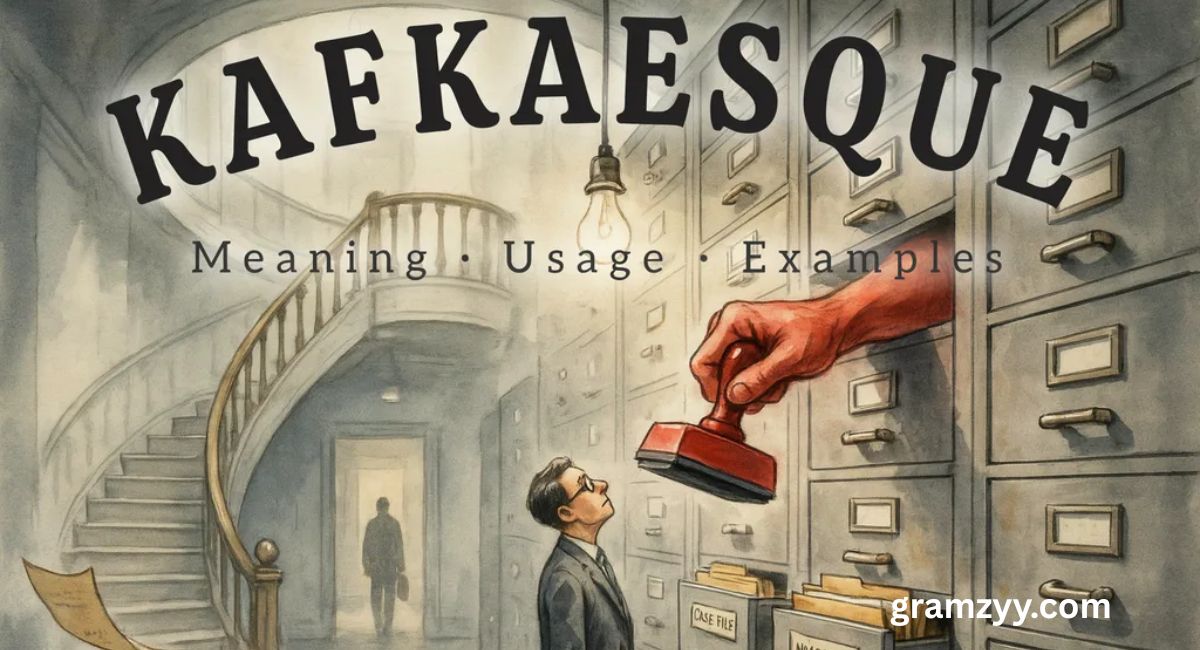
Kafkaesque Meaning: You’ve probably heard someone describe a frustrating visit to the DMV or a tangled visa application as “Kafkaesque.” It’s one of those words that sounds impressive in a sentence, but most people who use it couldn’t say exactly where it came from or whether they’re using it correctly.
This guide breaks down what Kafkaesque really means, where it comes from, how it’s used correctly (and incorrectly), and the most common mistakes people make with it.
What Does Kafkaesque Meaning?
Kafkaesque meaning is an adjective used to describe a situation that is needlessly complicated, illogical, and disorienting, usually involving a bureaucracy or authority that seems impossible to reason with. It often carries an undertone of dread or helplessness, as if the person trapped in the situation has no real way out.
The word comes from Franz Kafka, the early 20th-century writer whose novels and short stories repeatedly placed ordinary people inside nightmarish, rule-bound systems that made no sense to them. Dictionaries generally describe it in two connected ways:
- A nightmarish, surreal quality marked by confusion and a looming sense of danger
- A bureaucratic nightmare in which a person is dehumanized by an illogical, labyrinthine system
Both senses point back to Kafka’s fiction, particularly The Trial, in which a man is arrested and prosecuted for a crime that is never named or explained to him, and The Metamorphosis, in which a man wakes up transformed into an insect with no one able to offer him a rational explanation.
In plain English, when something is Kafkaesque, it feels like you’re stuck inside rules that don’t add up, dealing with people or systems that won’t give you a straight answer, and there’s no clear way to escape the mess.
See also: Introduction To vs Introduction Of: What’s the Difference?
When Should You Use Kafkaesque?
Kafkaesque works best when you’re describing a real or fictional situation that has these specific qualities:
- Excessive, confusing bureaucracy or red tape
- A sense that the rules are arbitrary, contradictory, or unexplained
- A feeling of helplessness or being trapped
- An undertone of absurdity, sometimes verging on the surreal
It’s a strong, evocative word, which is exactly why writers reach for it so often when describing immigration paperwork, insurance claims, court proceedings, or corporate red tape.
How This Usage Has Evolved
The word first appeared in English roughly 16 years after Kafka’s death, and writers quickly latched onto it because no other adjective captured that exact blend of bureaucratic dread and absurdity. Its use spread well beyond literary criticism into journalism, politics, and casual conversation.
That popularity came at a cost. Because Kafkaesque meaning is so vivid and convenient, people now apply it to almost any frustrating or confusing situation, even ones with little connection to Kafka’s actual themes. Language commentators point out that this looser usage has diluted the word’s precision, turning it into a catch-all for “annoying” rather than reserving it for true bureaucratic absurdity layered with menace.
When to Use It — and When to Avoid It
| Situation | Is Kafkaesque the Right Word? | Why |
|---|---|---|
| A multi-week visa process with contradictory requirements and no clear contact person | Yes | Bureaucratic, illogical, and disorienting |
| A long line at the grocery store | No | Simply slow, not illogical or threatening |
| A court case where the charges are vague and the defendant can’t get answers | Yes | Mirrors the plot of The Trial directly |
| A coworker being mildly rude in an email | No | Unpleasant, but not bureaucratic or surreal |
| A healthcare claim denied for unclear reasons, then re-denied after appeal with no explanation | Yes | Arbitrary system, no resolution in sight |
| Misplacing your car keys | No | Inconvenient, not systemic or absurd |
A simple rule of thumb: if you removed the bureaucracy or institutional rule-making from the situation, would it still feel Kafkaesque? If not, a different word probably fits better.
See also: There Has Been vs There Have Been — What’s the Difference?
How Do Writers Use Kafkaesque in Real-World Contexts?
Professional writers, journalists, and novelists use Kafkaesque to add weight and atmosphere to descriptions of dysfunctional systems. It shows up constantly in news coverage of immigration, healthcare, tax disputes, and corporate scandals because those topics so often involve exactly the kind of opaque, rule-bound frustration Kafka wrote about.
Correct Usage Examples
- “Trying to get a refund from the airline turned into a Kafkaesque ordeal of automated phone trees and contradictory emails.”
- “The immigration system she described was Kafkaesque: every form required another form, and no official could explain why.”
- “His insurance denial letter cited a clause that didn’t exist, then a second denial cited a different clause — a genuinely Kafkaesque runaround.”
- “The court proceedings had a Kafkaesque quality, since the charges were never clearly stated to the defendant.”
These examples work because they combine confusing rules, a lack of clear answers, and a sense that the person is stuck without recourse.
Incorrect Usage Examples
- “My commute was so Kafkaesque today.” (Traffic delays aren’t bureaucratic or surreal — this is simply annoying.)
- “This homework assignment is so Kafkaesque.” (Difficult or tedious schoolwork doesn’t carry the dread or illogical-system quality the word requires.)
- “The restaurant service was Kafkaesque.” (Slow or rude service is a customer experience issue, not a systemic, rule-bound nightmare.)
These misuses aren’t grammatically wrong, but they stretch the word past its real meaning, which is exactly the kind of overuse that critics point to when they say Kafkaesque has lost some of its punch.
Context Variations
| Context | Typical Usage | Example |
|---|---|---|
| Journalism | Describing dysfunctional government or corporate systems | “Reporters called the visa backlog Kafkaesque.” |
| Literature & criticism | Describing fiction with surreal, bureaucratic dread | “The novel’s prison scenes are deliberately Kafkaesque.” |
| Everyday conversation | Venting about red tape (often used loosely) | “Cancelling my subscription was Kafkaesque.” |
| Legal and political commentary | Describing opaque rulings or processes | “Critics called the tribunal’s secrecy Kafkaesque.” |
What Are the Common Kafkaesque Mistakes?
Even confident writers slip up with this word. Here are the mistakes worth watching for:
- Confusing it with Orwellian. Kafkaesque describes confusing, illogical bureaucracy that traps an individual. Orwellian describes deliberate surveillance, propaganda, and control, drawn from George Orwell’s 1984. Senseless red tape with no clear villain calls for Kafkaesque; intentional manipulation of truth calls for Orwellian.
- Using it for any mildly annoying situation. Slow traffic or a broken printer are inconveniences, not Kafkaesque scenarios, since they lack the systemic absurdity and dread the word implies.
- Forgetting the capital K. Because it’s derived from a proper name, Kafkaesque is conventionally capitalized, similar to “Orwellian” or “Dickensian.”
- Adding an unnecessary hyphen. Like most -esque words, it doesn’t need one; “Kafkaesque,” not “Kafka-esque.”
- Overusing it in one piece of writing. Repeating such a vivid word too often quickly dulls its impact. Save it for the moment that truly deserves it.
Memory Tricks That Stick
- Picture Kafka’s own most famous story: a man wakes up turned into an insect with absolutely no explanation. That sense of “this makes no sense, and no one will explain it” is the heart of Kafkaesque.
- Remember the phrase “trapped in red tape.” If paperwork, rules, or officials are involve and nobody can give a straight answer, you’re likely in Kafkaesque territory.
- Contrast it with Orwellian: Orwell = Big Brother watching you on purpose. Kafka = a maze with no exit and no villain, just endless rules.
- Think “K” for confusing. Kafka’s protagonist in The Trial is even named Josef K., a man lost in a system that never explains itself.
Etymology Note
Kafkaesque is an eponym, a word formed from a person’s name, in this case Franz Kafka, the German-language writer born in Prague in 1883. Kafka died in 1924, largely unrecognized outside a small literary circle, but his posthumously published novels, especially The Trial and The Castle, left such a mark on readers that critics began using his name as an adjective within about two decades of his death. The word entered English dictionaries by the mid-20th century and has stayed in steady use ever since, appearing wherever a writer needs to capture that specific flavor of bureaucratic, illogical dread.
See also: For Your Records: Meaning, Usage, and Examples
Conclusion
Kafkaesque is a precise, evocative word when used correctly: a confusing, rule-bound system that traps a person with no clear way out and no one willing to explain why. It loses its power when applied to ordinary annoyances like slow traffic or rude service. Reserve it for situations that genuinely echo Kafka’s fiction — opaque bureaucracy, arbitrary rules, and a creeping sense that reasoning your way out simply isn’t possible. Used sparingly and accurately, it remains one of the most useful literary adjectives in the English language.
FAQs
What does Kafkaesque meaning in simple terms?
It describes a confusing, frustrating situation involving illogical rules or bureaucracy, where there’s no clear way to fix the problem or get a straight answer.
Is Kafkaesque always negative?
Yes, it almost always carries a negative, unsettling connotation tied to confusion, helplessness, or dread.
Where does the word Kafkaesque come from?
It comes from Franz Kafka, a writer whose novels often featured characters trapped in nightmarish, illogical bureaucratic systems.
Is Kafkaesque the same as Orwellian?
No. Kafkaesque refers to confusing, absurd bureaucracy, while Orwellian refers to deliberate government surveillance, propaganda, and control.
Should Kafkaesque be capitalize?
Yes, it conventionally capitalized since it derives from a proper name, though informal usage sometimes lowercases it.
Can Kafkaesque describe a person rather than a situation?
Not typically; it almost always used to describe situations, systems, or experiences rather than individual people.
Is it correct to write “Kafka-esque” with a hyphen?
No, the standard spelling drops the hyphen, matching other -esque words like “statuesque” and “picturesque.”