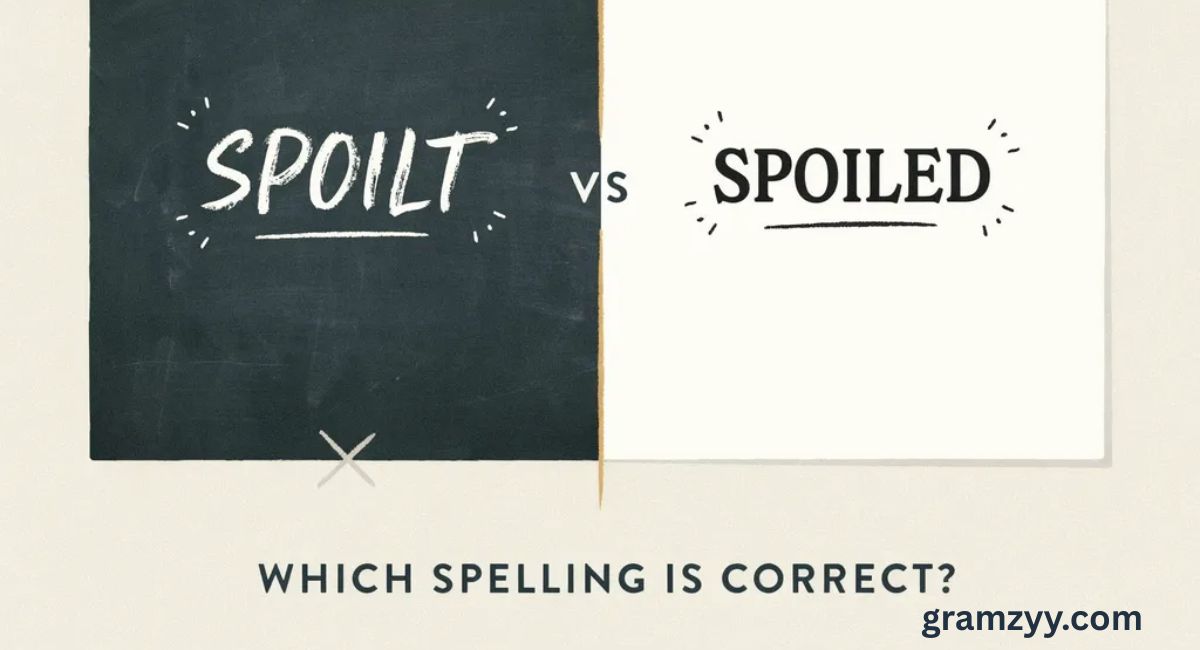
If you’ve ever stopped mid-sentence wondering whether to write spoilt vs spoiled, you’re far from alone. This question trips up native speakers, ESL learners, and professional writers alike. The short answer: both spellings are correct — but where you use each one depends on your audience and regional English variety. This guide breaks down everything you need to know so you never second-guess yourself again.
What Spoilt and Spoiled Mean
Both spoilt and spoiled are past tense and past participle forms of the verb to spoil. The verb itself carries two main meanings:
- To ruin or damage something — food going bad, a plan falling apart, or a moment being ruined
- To overindulge someone — typically a child who is given everything they want without limits
So when someone says “the milk is spoiled” or “the milk is spoilt,” they’re saying exactly the same thing. The meaning does not change. Only the spelling changes — and that change signals which dialect of English a writer is using.
How Spoilt and Spoiled Work in Real Sentences
Both forms function as:
- Simple past tense — describing what happened at a specific time
- Past participle — used with helping verbs like has, have, or was
- Adjective — describing a noun directly
Understanding these grammatical roles helps you use each form with confidence.
Spoiled in a Sentence
- The heavy rain spoiled our picnic. (simple past tense)
- The leftovers have been spoiled since Tuesday. (past participle)
- Don’t give in to a spoiled child’s tantrum. (adjective)
Spoilt in a Sentence
- The surprise was spoilt by a leaked message. (simple past tense — British English)
- The milk has gone spoilt in the summer heat. (past participle — British English)
- She grew up as a spoilt only child. (adjective — British English)
Correct Usage Examples
Here are sentences where each spelling is used correctly, matched to the appropriate dialect:
| Sentence | Form Used | Dialect |
|---|---|---|
| The food spoiled before we could eat it. | Spoiled | American English |
| Bad weather spoilt the outdoor wedding. | Spoilt | British English |
| He has spoiled that child rotten. | Spoiled | American English |
| She was spoilt by her grandparents. | Spoilt | British English |
| The ending was completely spoiled by the review. | Spoiled | Universal |
| The holiday was spoilt by illness. | Spoilt | British English |
Incorrect Usage Examples
Even experienced writers slip up. Here are common errors to avoid:
- ❌ The food is spoil. → Missing the past tense ending entirely
- ❌ He was spoilted by his parents. → Invented form that doesn’t exist
- ❌ The child was spoilt, and the food spoiled. → Mixing both spellings in the same piece of writing
- ❌ The milk has spoilt — written in an American English context where spoiled is the standard
The last point matters: mixing British and American spelling in the same text is a consistency error. Pick one style and stick to it throughout.
Context Variations
The word spoil and its past forms show up in several distinct contexts. Here’s how each plays out:
Food and Physical Objects
When describing something that has gone bad physically:
- The cheese has spoiled. (US)
- The cheese has gone spoilt. (UK)
Children and Behavior
When describing overindulgence:
- A spoiled brat (US)
- A spoilt child (UK)
Both carry the same tone and meaning — neither is harsher or more critical than the other.
Plans and Events
When something ruins an occasion:
- Rain spoiled the game. (US)
- Rain spoilt the game. (UK)
Election Ballots
A niche but real usage — ballots that are intentionally or accidentally rendered invalid:
- There were more spoiled ballots than the margin of victory. (common in both varieties)
See also : Raise Cain Meaning, Examples, and How to Use It
Common Spoilt vs Spoiled Errors
Writers most often make these mistakes:
- Using spoilt in American English writing — American editors may flag this as an error or an archaic form
- Using spoiled in formal British writing — while technically acceptable, it can feel inconsistent with the surrounding style
- Forgetting the past tense entirely — writing spoil when the sentence clearly needs a past form
- Confusing the adjective and verb forms — both spoilt and spoiled can be adjectives, but only the past tense form works after time-specific verbs
The biggest mistake of all: switching between both spellings within the same document. Consistency signals professionalism.
A Fast Way to Remember the Difference
Here’s a simple memory trick that works every time:
“Spoiled” ends in -ed, just like most regular American verbs. If you’re writing for an American or global audience, the -ed ending is always the safe choice.
You can also think of it this way:
- Spoil + ed = Spoiled → America and Canada
- Spoil + t = Spoilt → Britain, Australia, and much of the Commonwealth
If you’re unsure about your audience, always default to spoiled. It’s recognized and accepted everywhere.
When Does Each Spelling Fit Best?
| Situation | Best Choice |
|---|---|
| Writing for a US audience | Spoiled |
| Writing for a UK/Commonwealth audience | Spoilt or Spoiled |
| Academic writing in American English | Spoiled |
| Formal British publications | Spoilt (as adjective/participle) |
| Global or international content | Spoiled |
| Informal British speech or writing | Either |
| IELTS/TOEFL (American style) | Spoiled |
| IELTS/TOEFL (British style) | Either |
How the Usage Varies by Region
Regional preference is the core reason this debate exists at all. English evolved separately on different continents, and that produced two slightly different spelling systems.
American and Canadian English
In North America, spoiled is the only standard form. It functions as:
- The simple past tense: It spoiled overnight.
- The past participial adjective: the spoiled milk
The form spoilt is so uncommon in American writing that many readers may view it as a typo. Major American publications — from the New York Times to academic journals — consistently use spoiled.
British English
British English is more flexible. Writers use spoiled for the simple past tense and often use spoilt specifically as an adjective or past participle. For example, the Guardian and Telegraph regularly publish sentences like “a spoilt holiday” or “spoilt children.” However, spoiled also appears frequently in British writing, especially in a verb role.
Australian, Irish, and South African English
These varieties generally follow British conventions, making spoilt acceptable — particularly as an adjective. Spoiled is still common and causes no confusion.
The Historical Reason for Both Forms
English once allowed two different ways to form the past tense of certain verbs — a regular -ed ending and an older -t ending. You can see this same pattern in pairs like learned/learnt, dreamed/dreamt, and burned/burnt. American English gradually standardized toward -ed, while British English preserved both options.
See also : Who Else vs Whom Else — Usage and Rules
When to Use It, and When to Avoid It
Use spoiled when:
- Writing for a US or Canadian audience
- Publishing globally or for a mixed readership
- Working in journalism, academic writing, or formal American English
- You’re unsure which form suits the audience
Use spoilt when:
- Writing specifically for a British or Commonwealth audience
- Following a British style guide (e.g., Oxford, Guardian)
- The surrounding text already uses British English conventions
Avoid either form when:
- You mix them in the same document — pick one and stay consistent
- You use spoil where the sentence needs a past tense form
What Should You Remember About Spoilt and Spoiled Usage?
Here are the key takeaways worth keeping:
- Same meaning, different spelling — there is no difference in definition between spoilt and spoiled
- Regional preference drives the choice — American English uses spoiled exclusively; British English accepts both
- Spoiled is the safer global default — it works in every English-speaking country without sounding unusual
- Consistency matters more than perfection — whatever you choose, use it throughout your entire piece
- Both are grammatically correct — neither form is wrong in the right context
Whether you’re editing a blog post, writing an essay, or crafting a professional email, the choice between spoilt and spoiled comes down to knowing your reader. Once you do, the right word practically picks itself.
See also: Time Slot vs Timeslot — Which Is Correct?
FAQs
Is “spoilt” a real word?
Yes, spoilt is a legitimate English word — it’s the British English past tense and past participle of spoil, widely used in the UK, Australia, and other Commonwealth countries. (spoilt vs spoiled)
Which is more correct: spoiled or spoilt?
Both are grammatically correct. Spoiled is preferred in American English and is the safest choice for a global audience, while spoilt is standard in British English contexts.
Can I use “spoilt” in American English?
Technically yes, but it may confuse American readers or be flagged as a spelling error. Stick to spoiled when writing for a US audience. (spoilt vs spoiled)
Is “spoilt brat” or “spoiled brat” correct?
Both are correct — spoilt brat is the British form, and spoiled brat is the American form. Both mean exactly the same thing.
Does “spoilt” sound old-fashioned?
In American English, yes, spoilt can sound archaic. In British English, it sounds completely natural and current.
Should I use “spoiled” or “spoilt” for food?
Use spoiled for American English (“the milk has spoiled”) and either form for British English, though spoilt is often preferred as an adjective (“spoilt milk”).
Which spelling is better for SEO?
Spoiled generally performs better in global search because it’s the dominant spelling worldwide. However, targeting British audiences may benefit from including spoilt as well. (spoilt vs spoiled)